March 19, 2026
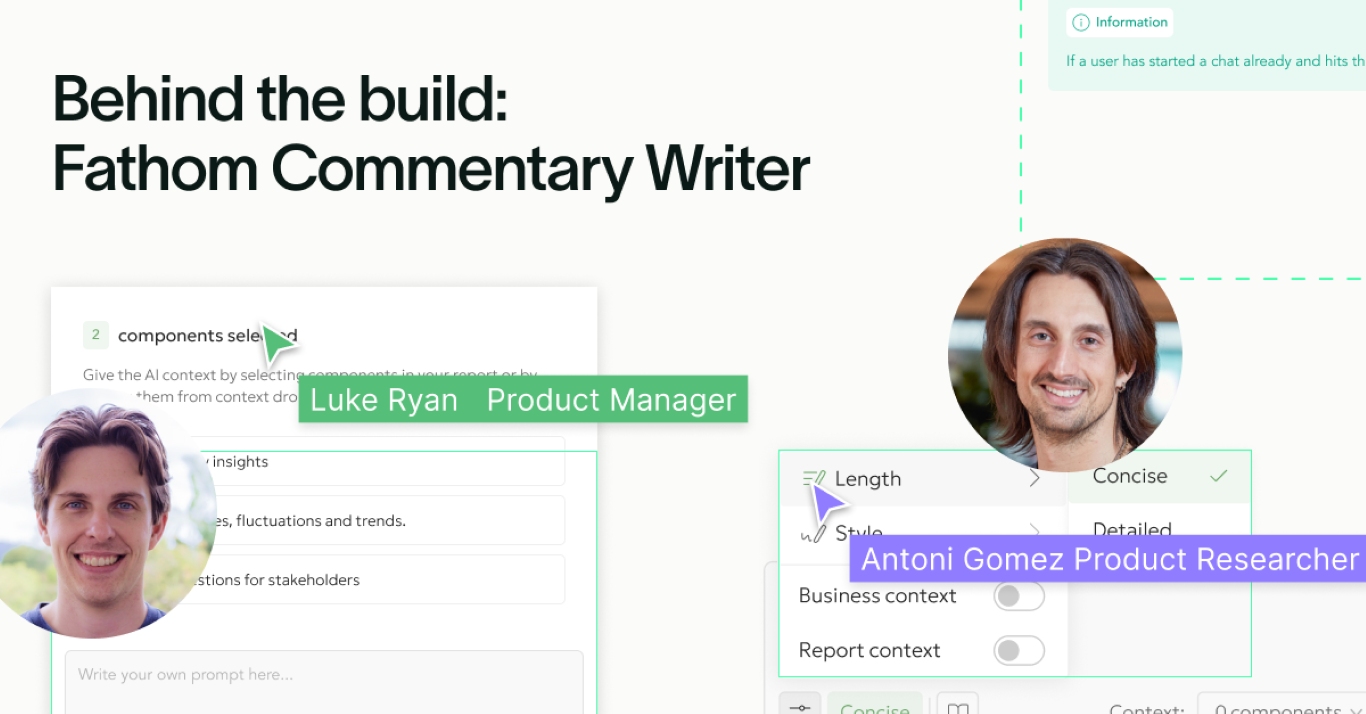
Luke Ryan, Senior Product Manager & Antoni Gomez, Product Strategy & Research Lead take you through the process of building Commentary Writer.
When we started building Commentary Writer, the goal wasn't to add AI for the sake of it. It was to solve something real:
Writing clear, accurate, meaningful commentary takes time. And even then, you're never 100% sure you've captured everything that matters.
Here's what we saw and how we approached it.
The issue wasn't that AI couldn't generate commentary. It was that the output often wasn't good enough for management reporting.
As Luke explains:
"Competitor solutions miss on several key factors: flexibility of inputs, trust and auditability of outputs, and contextual information to provide higher quality responses."
In other words, you could get words on a page. But could you trust them? Could you guide them? Could they reflect your business?
Antoni noticed something similar:
"It could be quite rigid, and it could be quite generic." Rigid, because you couldn't shape the output. Generic, because it focused on numeric movements, not the story behind the business.
And customers? Their expectations were high.
"The expectation of what we should be able to do with AI was really high, despite the fact I couldn't see many products meeting those standards."
The real problem wasn't speed. It was confidence.
Generic AI doesn't "fail" in finance, but it rarely reaches the level needed for board-ready reporting.
Management reports bring together:
- Actuals
- Budgets
- Forecasts
- KPI results
- Targets
-Non-financial metrics
That's layered, connected information. Without the right context and integration, the output becomes surface-level.
Antoni breaks it down into two audiences:
"It's nice to know a fall in profit margins is bad. But they need to know what it means for them."
That's the difference between describing numbers and explaining a business.
Originally, we built a “whole report” commentary option. The idea was simple: feed in everything and generate commentary across the entire report. Then we paused.
Luke explains:
“We realized the volume of data would produce lower quality results. The AI model has to consider everything, but not everything in a report is relevant for commentary.”
Reports often contain supporting data. Commentary should focus on what matters. So we pivoted.
Instead of whole-report commentary, we moved to a component-driven workflow. You choose the section. The AI focuses on what’s relevant. The output improves. For Antoni, the turning point was something else:
“Context. When we floated the idea of a context window that people could use to inform the model of the most important information about the business, they got very excited.”
That reaction was clear. AI needs more than numbers. It needs context.
Two things matter deeply: user experience and transparency. Luke is direct about one non-negotiable:
"We refused to compromise on symbolic attribution."
Symbolic attribution cross-references every figure generated by the AI and shows the breakdown of each calculation. It wasn't the simplest route. Handling and rendering different mathematical expressions adds complexity. But in finance, transparency isn't optional.
You need to see the working, not just read the answer. At the same time, the experience had to feel intuitive. Antoni explains:
"The team wanted to give users flexibility without making the UI confusing and complex."
Powerful, but clear. Flexible, but not overwhelming.
Even small details — like how attribution loads — were carefully designed to make the experience feel smooth and considered.
In finance, “almost right” isn’t good enough.
To reduce hallucination risk, the team combined:
- Symbolic attribution for full traceability
- Extensive red teaming and testing
- A carefully engineered, tailored system prompt
- Deep integration with structured financial data
Antoni highlights the work behind the scenes:
“We’re lucky to have a colleague with a PhD in Machine Learning who did an extraordinary amount of testing, red teaming, and training to minimize hallucinations.”
The result isn’t just AI that generates commentary. It’s AI that shows you how it got there.
Letting go of the “whole report” approach was difficult. It sounded comprehensive. It looked impressive. But it didn’t deliver the level of quality finance teams expect. Choosing to focus over scale was the right move, even if it wasn’t the obvious one.
The other tension was flexibility versus simplicity. Too much control, and the experience becomes confusing. Too little, and it feels rigid. Finding that balance took iteration, care, and a lot of refinement.
Commentary Writer isn’t about automating words.
It’s about helping you move from reporting numbers to explaining what they mean.
It means:
- Less time assembling repetitive commentary
- Greater confidence that nothing critical is missed
- Clear explanations for non-financial stakeholders
- Full visibility into how every number is derived
- It supports your narrative, it doesn’t replace it.
And perhaps most importantly, it builds trust. Not through buzzwords. Not through bold claims.
But through clarity.
Because when AI can explain itself, you can stand behind it.
Want to see how Business Context shapes real financial commentary? Explore Fathom's Commentary Writer and try it with your own data.

Ellie is a campaign marketing manager at Fathom, with a degree in branding and marketing. With a background in campaign strategy and creation, Ellie is passionate about showcasing how Fathom can make a real difference to finance professionals and businesses.